

Oklahoma's historical recognition as one of college football's premier programs is largely based on outstanding offensive design and performance that spans more than eight decades.
If Sooner football through the ages is known for any one thing, it is high-powered offenses and the ability to put more points on the scoreboard than 74% of its opponents.
The Split-T offenses run by Oklahoma's juggernaut 1950s teams, coached by the legendary Bud Wilkinson, won three national championships. Barry Switzer may not have invented the Wishbone offense, but he clearly perfected it, leading to three more OU national titles, and Bob Stoops' teams went to the air with spread formations and an Air Raid offensive approach that enabled him to becoming the winningest head coach in Sooner football history.
Read more: Bob Stoops' retirement closes the final chapter of his coaching legacy
This, of course, is not to suggest that Oklahoma didn't win quite a few games playing elite defense. The best teams are those that are productive and efficient doing both and in complementary fashion.
What OU team led the nation in both scoring offense and scoring defense?
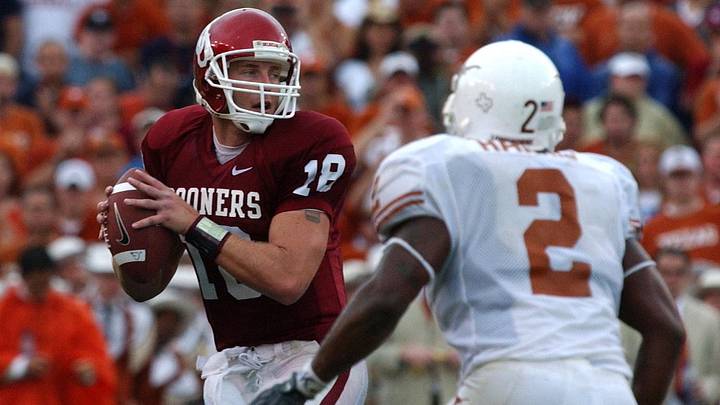
In 2003, Oklahoma ran the table during the regular season winning all 12 games. During that stretch, the Sooners outscored their opponents by 422 points (580-158), posting 50 or more points in seven of the 12 games. During the regular season, that OU team, quarterbacked by Heisman Trophy winner Jason White, averaged 48.3 points per game.
The 2003 Oklahoma team not only was a high-scoring team, but also played stout defense, allowing just 158 total points through 12 regular-season contests, an average of 13.2 points a game. Five times, opponents scored nine or fewer points against the Sooners, and on eight different occasions, no team scored more than 13.
That Oklahoma team finished the 2003 regular season with both the country's No. 1 scoring offense and No. 1 scoring defense, the only time in program history that has happened.
The Sooners were surprised in the Big 12 Championship Game that season, losing 35-7 to Kansas State. Because of their overall dominance during the regular season, however, the Sooners retained the No. 1 ranking in the BCS rankings and were matched against No. 2 LSU in the national championship game. Oklahoma allowed just 21 points to LSU, but scored only 14 themselves and lost 21-14.
 Add us as a preferred source on Google