

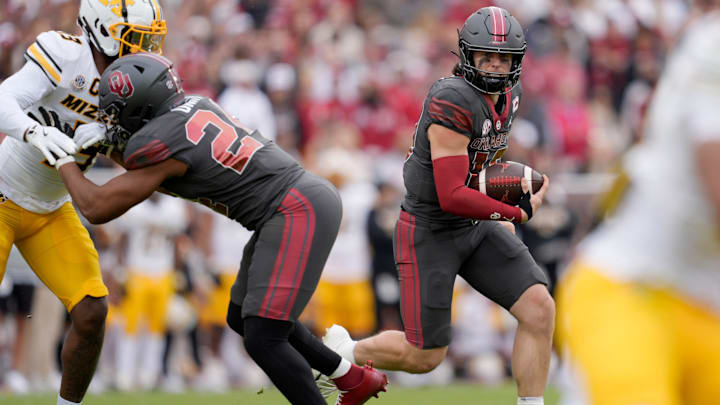
They say great offense wins plenty of games, but great defense wins championships. And guess what? Oklahoma has one of the best defenses in college football this season.
Historically, Oklahoma has featured some of college football's most productive, high-scoring offenses, powering the Sooners to seven national championships. To be completely fair, though, those OU championship teams were also marked by elite defensive performance.
OU offense must improve before College Football Playoff
In 2017, 2018 and 2019, three of Oklahoma's last four College Football Playoff appearances, the Sooners ranked No. 1, No. 1 and No. 3, respectively, in total offense. Unfortunately, OU's offensive performance this season finds itself on the opposite end of the scale -- 78th in scoring offense (26.4) and 90th in total offense (353.7 yards per game) -- as the No. 8 Sooners prepare to host No. 9 Alabama in the opening round of the playoff.
Oklahoma made several offseason changes after last season to improve the offensive output, bringing in new offensive coordinator Ben Arbuckle from Washington State, as well as quarterback John Mateer, also from Washington State, considered the top quarterback in the Transfer Portal. The Sooners also bolstered other skill positions in the offense with portal additions and top signees in the 2025 recruiting class.
The reengineered offense lived up to preseason expectations through the first three games of the 2025 season. Led by Mateer, OU averaged 33.6 points and 476 yards per game. In Game 4 against Auburn, however, Mateer suffered a broken thumb that required surgery. Remarkably, Mateer missed just one game after the surgery, but the offense has not really been the same since.
Mateer showed enormous grit and determination by returning as soon as he did, but it was also at a point in the season when the competition was ramping up with the bulk of the SEC schedule ahead on the schedule.
Although Mateer has shown marked improvement in recovery from the injury with each passing week, it was still noticeable that the effects and limitations were still there. Over the final six games with Mateer at quarterback, he wasn't as accurate with his throws with a completion percentage hovering around 60%, his passing yards were under 200 yards in four of the six games, and he had just four touchdown passes and seven interceptions compared to five touchdown throws and three interceptions prior to the injury.
Mateer's injury is just one of the problems, though, that has led to Oklahoma's inconsistency on offense this season and made scoring points a troublesome task. While OU averaged 33.6 points in its first three games of the season, following Mateer's injury that number dropped to 21.1 per game. Had the defense not been one of the best in the country, the Sooners easily could have lost six of its final seven games.
Injuries on the offensive line have plagued Oklahoma for a second straight season, forcing three freshmen into the starting lineup for the final few games. The Sooners also have struggled to run the ball effectively for most of the season. OU ranks 106th out of 136 FBS teams in rushing offense, averaging 123.8 yards per game and 3.7 yards per carry.
And against teams with truly elite defensive fronts, which exist throughout the SEC, as well as in the teams that make up this year's College Football Playoff bracket, productivity in the run game has been a huge challenge for Oklahoma this season.
Being able to run the ball and avoid negative plays is paramount for Oklahoma if it is going to avoid being eliminated, once again, in its first playoff game. Teams need to be able mount an effective rushing attack to keep defenses honest and avoid becoming one-dimensional and predictable on offense.
OU's passing game is adequate, but not great. That requires the Sooners to mix in effective run plays and run-pass option plays, which also have the residual effect of increasing downfield passing opportunities.
There's little question the Oklahoma defense is the biggest reason the Sooners fashioned a 10-2 record this season and are playing in the College Football Playoff one year after finishing 6-7 and completely reversing a 2-6 record against SEC opponents in 2024 to 6-2 this season.
The Sooner offense managed to do just enough for Oklahoma to finish out the season with four consecutive November wins despite averaging 22.5 points a game and going against four of the highest-scoring teams in the SEC this season. Three of the four teams were ranked in the top 25 at the time the game was played and two were on the road (Tennessee and Alabama) at two of the most difficult places to play in all of college football.
In each of Oklahoma's four previous CFP appearances, it was the offense that was the overriding strength of the team, seemingly at the expense of defense and special teams. Ironically, this time around it is defense and special teams excellence that are the drivers behind the Sooners' return to the playoff stage.
Unfortunately, the same fate as before likely awaits playoff-bound Oklahoma unless it is able to come up with more effective and balanced play designs and executional adjustments to lift some of the pressure off Mateer's shoulders and help the offense be a stronger contributor to the team's overall success.
Some Sooner Magic certainly wouldn't hurt, either.
 Add us as a preferred source on Google