

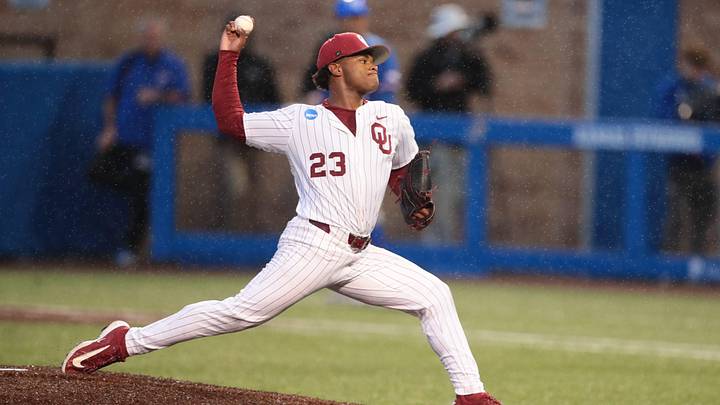
The Oklahoma bats have come alive at just the right time of the season, delivering timely and productive hits and a barrage of long balls in a five-game postseason win streak that has catapulted the Sooners to what just a few short weeks ago seemed like an improbable trip to the Men's College World Series.
The Sooners (38-22) are one of five SEC teams that make up the eight-team field for the 2026 Men's College World Series.
Over the past two weekends, Oklahoma has knocked off the tournament's No. 2 overall national seed Georgia Tech, eliminating arguably the country's best offensive team on its home field, and this past weekend the Sooners did the same to No. 15 Kansas, and in dominant fashion.
As a result, the Sooners have earned themselves a bonus trip to Omaha, Nebraska, and a 12th MCWS appearance, which ties Oklahoma with four other teams for the 10th most in NCAA Division I history.
As hot as the Sooner bats have been over the past two weeks, though, if the Sooners are to have success in this year's College World Series and potentially win what would be a third national championship in the sport of baseball, it will be the OU pitching that will be the determining factor.
The Oklahoma pitching performance, especially from the starting rotation, has been an enigma all season. Like the classic nursery rhyme by Henry Wadsworth Longfellow about "the little girl with the curl," when Sooner pitching has been good this season, as it has been of late, it has been very good. Conversely, though, when it has been bad -- well, you know where I'm going with this.
Over the last five games, the Oklahoma offense is scoring 11.8 runs per game and has pounded out a total of 69 hits, an average of 13.8 a game, and 14 of those left the yard. This coming from an OU team that had averaged around six runs per game for most of the season and ended the regular season with a team batting average of .280, seventh-best in the SEC.
It's not over till it's over, and it will be pitching not hitting that ultimately decides when it is
This time of the season, however, you can't count on being able to outscore your opponent, most of whom have gotten this far because of their ability to produce hits and score runs in ample quantities. Great pitching will always win over great hitting, and that's what the Sooners are going to have to continue to have against some very good offensive lineups Oklahoma will face in the MCWS.
The OU pitching staff stepped up and held its own against the high-powered Georgia Tech offense, pounding the strike zone, limiting free passes and keeping the ball in the yard. You weren't going to keep that good of an offense off the bases or off the board, but the Sooners were able to keep the games close against the Yellow Jackets, and the OU offense found a way to get it done, having to come from behind in both of their regional wins over the Ramblin' Wreck.
Oklahoma's 8-1 win in the opening game of the Lawence Super Regional featured a career performance by OU freshman Cord Rager, who held the Jayhawks scoreless and with just one hit over 6.0 strong innings before turning over the mound duties to LJ Mercurius out of the bullpen. Mercurius, who has been a starter most of the season, closed out the win, allowing three hits and one run, an eighth-inning home run by Kansas right fielder Jordan Brock.
Read more: Sooners fall into the most gruesome Men's College World Series path
The Sooners have used 12 different pitchers in the last five games and have allowed 17 earned runs in 46.0 innings of work. That works out to an ERA of 3.33, down from a staff ERA of 5.15 for the season.
Both of the Oklahoma starters against Kansas were freshmen, which is an even stronger statement for the future. Xander Mercurius, brother of LJ, started Game 2 in the Lawrence Super Regional on Sunday against Kansas. He worked the first three innings, allowing one run on three hits and striking out five, before the skies opened up and forced the game to be suspended and resumed on Monday.
The freshman right-hander Mercurius also was on the mound for the start of Monday's game before turning over the pitching duties to reliever Nate Smithburg, who shut down the Kansas offense on one hit over the next nearly four innings.
In the two wins over Kansas, OU pitchers held the Jayhawks to just three runs on eight total hits and aided by 17 strikeouts.
If OU is able to sustain this level of pitching performance in the MCWS, it not only will take some of the pressure off the OU offense to have to score double-digit runs in order to win games, but is the best way for the Sooners stay alive and advance in the championship hunt.
 Add us as a preferred source on Google