

Most everyone who calls themselves fans of Oklahoma will never know of a time when the school's nickname was anything but Sooners.
Oklahoma officially became a state on 1907, and a year later adopted the designation as the "Sooner State." The term is a direct reference to the settlers who literally jumped the gun ahead of the official start of the Land Rush of 1889.
When did OU become the Sooners?
The school was actually founded 17 years before Oklahoma became a state, and for 10 years before OU became known by its current nickname, its athletic teams were referred to as either the Rough Riders or Boomers.
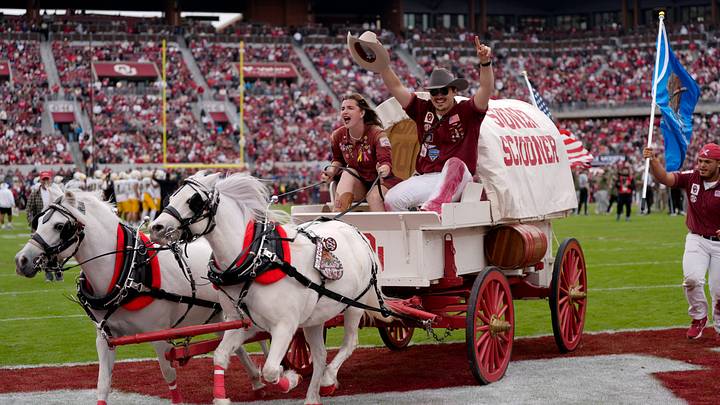
The Sooner Schooner is one of the country's most unique college mascots. A scaled-down version of a Conestoga wagon, representative of the popular mode of transportation of the pioneers who settled the Oklahoma Territory around the time of the 1889 Land Rush, the Sooner Schooner was introduced in 1964 as the school's official mascot. The wagon is powered by a pair of white Welsh ponies, not coincidentally named "Boomer" and "Sooner."
Read more: Oklahoma's iconic Sooner Schooner is one of a kind with a legendary history to match
The costumed version of the mascots Boomer and Sooner became part of the OU athletics fan experience in 2005.
The RUF/NEKS, the school's male-female spirit squad, is responsible for driving and maintaining the Sooner Schooner. It's not a big surprise how the name came about, derived in part from the earlier Rough Riders nickname of the football team. But the popular lore behind the RUF/NEKS name is that it came about from a disturbance created at an OU basketball game by a group of football players, prompting an elderly woman to shout out, "Sit down and be quiet, you roughnecks."
Interestingly, the word Sooner originally began as a derogatory term, used to describe those who broke the rules during the 1889 Land Rush. Over time, however, according to Encyclopedia Britannica, "it evolved into a symbol of ambition and a willingness to act, reflecting the pioneering spirit that shaped the state."
 Add us as a preferred source on Google