

Oklahoma men's basketball has been to the Final Four five times and the national title game twice, but 1988 was when the Sooners could've and should've won their first and only national championship.
A season like the OU men are experiencing in 2025-26, while agonizing to go through, should not take away from the much better times on the court and in the national headlines and the star performers who have graced the Oklahoma basketball program over the years. If anything, it makes it easier to look back and fully appreciate the glory years of Sooner basketball.
And there actually have been a number of them. Oklahoma began playing varsity intercollegiate basketball in 1908-09. In the first dozen years, the Sooners actually recorded more undefeated seasons (3) than losing seasons (1). OU had only moderate success in the first 72 years of existence, although it has only 17 losing seasons.
The Sooners' first real claim to fame came in 1939, when Oklahoma appeared in the very first NCAA Tournament Final Four, losing in one of the two regional finals, 55-37, to eventual national champion Oregon.
The Sooners returned eight years later for their second Final Four appearance. All-American Gerald Tucker, one of four Oklahoma players who have been awarded National Player of the Year honors, led the Sooners to the national championship game against Holy Cross. Future NBA Hall of Famer Bob Cousy was a freshman on that Holy Cross team that defeated OU 58-47 for the national title.
OU's glory years in men's basketball came over a period of 25 years in the '80s, '90s and early 2000s
When Billy Tubbs was named head coach of the Sooners in 1980, it began a period of nearly three decades that Oklahoma basketball firmly established itself as an elite competitor on the national stage. Tubbs' first OU team in 1980-81 posted a 9-18 overall record, the only losing record in Tubbs' 14 seasons at Oklahoma.
During the Tubbs era, Oklahoma won 333 games, the most of any of the Sooners' 14 head coaches all-time. His 1987-88 team won 35 games, the most in school history, losing just four times. His teams made nine NCAA Tournament appearances, including two Sweet 16s (1986, 1987), one Elite 8 (1985) and one national championship game in 1988. No. 1 seed Oklahoma lost to the 6th-seeded Kansas Jayhawks, a team OU had beaten twice in the regular season, 83-79 in the national championship game that season.
Eight of the 10 highest-scoring teams in school history were during Tubbs' tenure, including two that averaged more than 100 points per game. Tubbs coached four Big Eight conference championship teams in 1984, 1985, 1987 and 1988. Four Sooner All-Americans played under Tubbs in Wayman Tisdale, Stacey King, Mookie Blaylock and Harvey Grant.
Tubbs resigned from his position at Oklahoma in 1994 and was replaced by Kelvin Sampson, who continued the Sooners' basketball success and national prominence. Sampson's teams won 279 games, the second-most in program history, including 10 20-win seasons.
Sampson took Oklahoma to 11 NCAA Tournaments in 12 seasons, and the Sooners made postseason appearances in all 12 seasons he was at OU. His 2001-02 and 2002-03 Oklahoma teams advanced to the Final Four and Elite Eight, respectively. The Sooners lost to the Indiana Hoosiers in the Final Four of the 2002 NCAA Tournament.
Sampson's OU teams won an average of 23 games a year over 12 seasons, but they surprisingly won only one conference championship in 2004-05, and that was a shared title with Kansas. His teams did, however, finish second on four other occasions.
Under Tubbs and Sampson, Oklahoma men's basketball teams produced a combined record of 612-241, a winning percentage of .717, and made 20 NCAA Tournament appearances in 26 seasons. Tubbs is the winningest coach in program history, but Sampson has the best winning percentage at .722.
Sampson resigned from Oklahoma after the 2005-06 season to take the top job at Indiana. After leaving OU, it was discovered that Sampson and his staff had committed recruiting violations over several years while at OU, for which the Sooners faced NCAA penalties. He is currently in his 12th season as head coach at Houston.
In the 19 seasons since Sampson departed, Oklahoma basketball has had only modest success, but did include two exceptional seasons in 2008-09 and 2015-16.
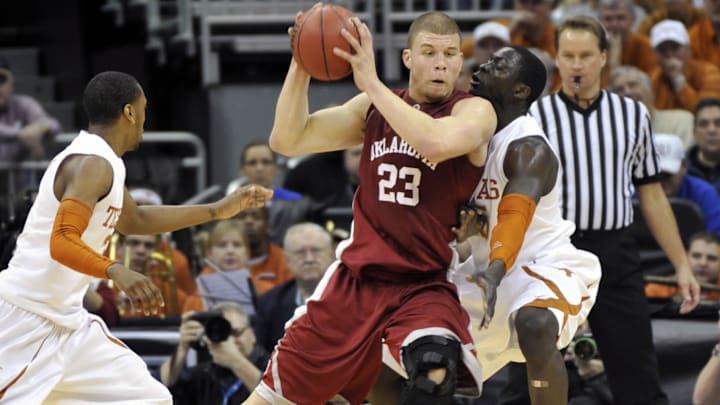
Jeff Capel, a former Duke star, succeeded Sampson. In five seasons in Norman, Capel's OU teams compiled an overall record of 96-69, which factors out to an average record of 19-14 per season. The best of those seasons unquestionably was 2008-09, featuring National Player of the Year Blake Griffin, who was awarded both the Naismith Award and the John R. Wooden Award. The Sooners went 30-6 that season, the third-best record in program history, and advanced to the Elite Eight, where they lost to eventual national champion North Carolina in the South Regional final.
Veteran college coach Lon Kruger followed Capel and was able to garner 195 wins over 10 seasons, including five 20-win seasons and a couple more with 19 wins. Interestingly, though, Kruger's teams had a losing overall record in the Big 12 at 89-90. The best of Kruger's 10 Oklahoma teams was 2015-16 with consensus First-Team All-American and National Player of the Year Buddy Hield.
Led by Hield's 29.3 scoring average in four Oklahoma victories as the No. 2 seed in the West Region of the 2016 NCAA Men's Tournament, the Sooners advanced to their fifth Final Four in school history. Oklahoma defeated top-seeded Oregon in the West Regional final and punched its ticket to the Final Four. That was where the Sooners' dream season ended, however, as it had several times before.
Villanova shot an unworldly 71% from the field and 61% from three-point range, and OU's Hield was held to just nine points, in a 95-51 blowout win over the Sooners in the national semifinals. It didn't really help soothe over any OU wounds that Villanova went on to win the national championship that season.
Since the 2015-16 season, a decade ago, Oklahoma has compiled an overall record of 170-142. The Sooners have made it to the NCAA Tournament just four times and advanced to the second round only once.
It's a fairly good bet Oklahoma will be making a coaching change and looking for another course correction in the Sooners' men's basketball program after this season, if not before. Football school or not, OU basketball has seen and experienced national success, and that should not be forgotten.
The Oklahoma women are holding up their end of the bargain. It's time again for the men to pull their weight on the hardwood and start delivering a better product and fan experience.
 Add us as a preferred source on Google