

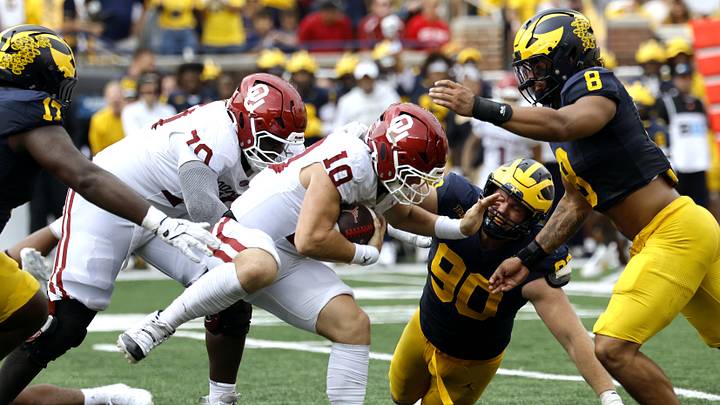
Saturday's highly anticipated showdown between Oklahoma and Michigan at the place appropriately named The Big House sadly amounted to little more than a big disappointment for Sooner fans.
Everyone knew the chances were very high that the Michigan team the Sooners faced on Saturday would be much different than the team that, by all rights, should have lost to Western Michigan just seven days before. What they didn't know or anticipate was that Oklahoma would turn back the clock and reprise the same offensive struggles for which it was so soundly criticized last season.
The Oklahoma offense was able to produce only three drives of 30-plus yards out of 11 total possessions. Two ended in second-half scoring drives (a touchdown and a field goal) and the third was thwarted by an OU fumble on the Michigan 26-yard line in the second quarter. The Sooners' only productive quarter was the third, in which they produced 129 yards of offense, or 45%, of their 289 total for the game.
Michigan scored a touchdown late in the first quarter on a career-best 38-yard run by sophomore quarterback Bryce Underwood and added a field goal right before halftime to take a 10-0 advantage into the locker room at the intermission.
Oklahoma came to life offensively on its first possession of the second half on an eight-play, 90-yard scoring drive that culminated on a 22-yard touchdown pass from John Mateer to former Washington State teammate Mackenzie Alleyne. The Sooners tacked on a 34-yard field goal by Tate Sandell in the opening moments of the final quarter to draw even at 10 each and return some hope to what had been a frustrating first three quarters for Sooner fans, who must have felt as if they were experiencing a hangover from the 2025 season
It was a brief reprieve, however, as four minutes later, Mateer applied a self-inflicted dagger to Oklahoma's chances, throwing an interception deep in Michigan territory that was returned to the six-yard line. The Wolverines' Jordan Marshall blasted into the end zone one play later with what proved to be the final puzzle piece in a 17-10 Michigan win, the Wolverines' first over the Sooners in three meetings.
It's still very early in the 2026 season, but Saturday's performance does not offer up much optimism for what to expect when Oklahoma crosses the path of two of the best teams in the country, Georgia and Texas, in just a few short weeks. Those two games could easily become blowouts, despite the Sooners' elite defense, if Venables and staff don't come up with some offensive adjustments, and quickly.
The good, the bad and the ugly of a performance that was far too little in a big game at The Big House:
The Good: Tight end Rocky Beers has a career game
Colorado State transfer Rocky Beers turned in one of his best games as a collegian, catching six of nine targets for 94 yards. In the third quarter, Beers caught a pass across the middle from John Mateer and took it 43 yards to the Michigan 40-yard line. That helped set up the 34-yard field goal that tied the game at 10 apiece.
A BIG 43-yard catch-and-run for @OU_Football TE Rocky Beers 😮💨 pic.twitter.com/GfjDx9KN0p
— FOX College Football (@CFBONFOX) September 12, 2026
In retrospect, Mateer should have looked for Beers more in the second half instead of trying to force the ball to Isaiah Sategna in tight coverage. Beers presented more of a matchup problem for the Michigan defense than Sategna, who was well covered the entire game.
The Bad: John Mateer's issues aren't fixed, and it's not the hand
Oklahoma obviously didn't play well on Saturday, but it still had every chance and could have won the game. The reason the Sooners did not win in Ann Arbor was John Mateer.
We saw the same problems from Mateer that we did the second half of last season -- trying to do too much, inaccurate throws and bad decisions with the ball -- and this time it was with a healthy throwing hand.
If we had seen the Mateer who led the Sooners on two scoring drives in the third quarter in any of the other three quarters, things might have turned out a little differently. Mateer completed all seven of his passes in the third quarter for 125 yards and a touchdown. The other three quarters, he was just 10-of-26 for 64 yards, with many of his throws sailing high and wide of the mark. For the game, Mateer was 17-of-33 passing, which was a 52% completion rate and his lowest since coming to Oklahoma.
The interception Mateer threw midway through the fourth quarter while standing inside his own 10-yard line was an absolute backbreaker and highly reminiscent of the pick-six he threw against Alabama in last season's College Football Playoff. Without a running game to speak of, the Sooners are having to rely on Mateer's passing skills, which are going to be even further exposed against the better defenses he will go against this season in the nine-game SEC schedule.
John Mateer with the game on the line pic.twitter.com/8XU1hoB68Q
— No Context Sooners (@nocontextsooner) September 12, 2026
The Ugly: Ben Arbuckles' play-calls hand-tied and killed any offensive momentum
Oklahoma offensive coordinator Ben Arbuckle was praised as one of the bright, young offensive minds in college football when he came to Oklahoma, along with quarterback John Mateer, ahead of the 2025 season. So far, the Sooners have yet to reap the expected rewards from that hiring. The Oklahoma offense has been a mitigated disaster since he took over the game-planning and play-calling. It's becoming a trend, and not a good one, for a program like Oklahoma.
The Sooners were running the ball fairly well in the early going against Michigan. Lloyd Avant averaged 5.3 yards per carry in the opening quarter and 8.5 per carry in the second quarter. That's an average of 6.6 yards per attempt in the first half. In the second quarter, however, and into the second half, Oklahoma had all but abandoned the running game, except for some designed quarterback runs and a couple of reverses utilizing wide receivers Isaiah Sategna and Trell Harris.
Avant was used on just four running plays in the second half, with Arbuckle electing to go to the air more heavily despite the fact that his quarterback was obviously struggling with accuracy issues. The Sooners knew coming into the season that they needed to run the ball better to win, and especially so against a team like Michigan.
Instead, Arbuckle stubbornly and inexplicably gave up on the run game and chose to rely on Mateer to move the offense with his arm and legs. As a result, the Sooners were never able to get into an offensive rhythm and became far too predictable. An easy adjustment for an opposing defense.
It appeared that every time the Oklahoma offense started to display some offensive success and rhythm in the Michigan game, Arbuckle would make a play call or two that would end up destroying all the momentum. Arbuckle -- and now Oklahoma -- is discovering that what worked at Washington State may not be good enough at a place like Oklahoma, which requires complementary offensive and defensive play to win against good teams and at the highest level.
 Add us as a preferred source on Google