

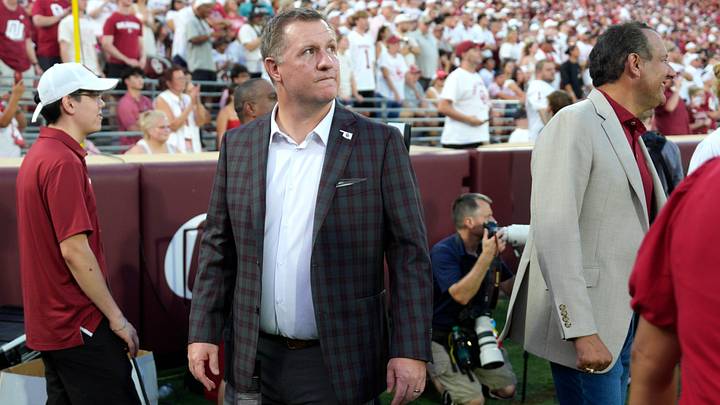
Oklahoma athletic director Roger Denny proclaimed that handing football coach Brent Venables an unnecessary contract extension just before the season started was “managed risk.” Well, just like many of us saw coming, it was mismanaged.
Two weeks before the Sooners’ 2026 season kicked off, OU gave Venables a two-year extension through 2031 that jolted his annual salary to be about $10.5 million a year and made him a top-10 highest-paid coach in college football.
“It’s managed risk,” Denny said then to defend the decision. “But I would tell you, I can’t -- I have to be aware of what our worst-case scenario is. But ultimately, for us to have success, I have to plan for success, right? I have to put our program in a position to be ready at every opportunity to not be so cautious about what the downside is that we all miss the upside.
“And so I’m certainly aware of it, and I’ve got to have an understanding of what it would cost if we got to that point. But at the end of the day, if I’m so focused on the downside, we’ll never realize our upside.”
Barely a month later, Denny already has his foot in his mouth. He was so caught up planning for success, that OU is now unprepared for the reality of failure.
Brent Venables is nearly unfireable no matter how 2026 goes
The Sooners enter their bye week at 2-2 with no sign of turning things around. Venables has a stellar defense again, but it’s not as great as last season. A lifeless offense is still haunting Venables’ program despite his apparent best efforts to fix it over the offseason. It's the same as every season under Venables, so what's to lead fans to believe anything will be different in 2031?
After losing its conference opener to Georgia 41-13, OU is staring down an eight-game SEC slate that includes six ranked opponents. Upsets happen in college football, but if the unranked Sooners don’t pull any off the rest of the way, then they’re destined for 4-8 and missing a bowl game for the first time since 1998, before Bob Stoops ever even donned an OU visor.
That would also continue Venables’ destructive pattern of 10-win seasons being followed by a losing record. He would post three losing records in five years leading the Sooners, which would match John Blake for the most by any OU head coach in the modern era.
Blake was obviously fired after doing it a third time. The biggest difference between Blake and Venables is that Blake did it three years in a row, while Venables would post 10 wins between each losing season. It’s also worth noting that Venables received a contract extension after both 10-win seasons despite losing efforts the year before.
Venables would have a career 36-28 record as a head coach if the Sooners really do finish 4-8. That dips dramatically to 20-23 in conference play between the Big 12 and SEC. That’s a .465 winning percentage in conference play, when things matter the most and life actually gets difficult.
Yes, a lot can happen over the next nine weeks of the season, but it’s still more realistic to brace for 4-8 than the success Denny had planned for.
A third losing season in five years at a blue-blood program with standards like Oklahoma should warrant a coaching change, especially if it's the worst yet under Venables after entering with national title aspirations.
What it would cost OU to fire Venables is a buyout that conveniently hasn’t been released yet. It would still for sure be more than the $34.9 million it was before the new extension.
Firing Venables would cost OU that, plus buying out his replacement from their current school and still having enough money to outbid anyone else who wants the same guy. The new coach would also need even more money to assemble a roster that can succeed in the SEC.
There was no need for OU to ever be in this predicament. If the Sooners meet expectations and return to the College Football Playoff, then, sure, reward Venables with a contract extension. No one was coming after him. If Denny was worried about an extension costing even more at that point, well, now losing will cost a lot more.
Denny has made Venables almost impossible to fire, no matter how bad 2026 gets.
Oklahoma bet against itself here, and instead of hitting the jackpot, this is already looking like a bad beat.
 Add us as a preferred source on Google