

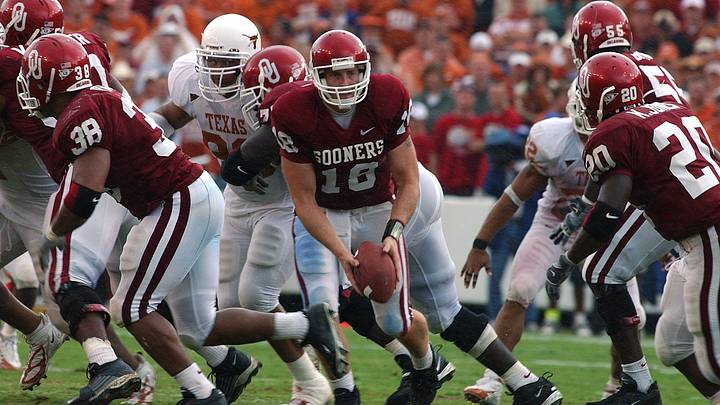
Oklahoma's seven national championships are tied with USC for the third most in the modern era of college football, but the Sooners' last national championship team was 26 seasons ago in 2000.
That is the longest gap between national titles since Oklahoma registered its first natty in college football over three-quarters of a century ago, back in 1950.
Since 2000, under the leadership of three head coaches (17 seasons under Bob Stoops, five under Lincoln Riley, and four full seasons so far under Brent Venables), Oklahoma has compiled an overall winning percentage of .788 (271-73), the third-highest among FBS teams over that time.
While it is true that Oklahoma doesn't have a national championship to show for its efforts in a quarter century, the program's overall record of success may be the best in any 25-year period in the team's history. During that time frame, the Sooners played in four BCS National Championship Games, appeared in four College Football Playoffs when the field was made up of just four teams (2015, 2017, 2018, and 2019), and another CFP when it was a 12-team format in 2025. Also during that stretch, Oklahoma won 14 Big 12 championships.
Over the past 26 seasons, the Oklahoma offense has ranked in the top 10 nationally 13 different times, including twice finishing No. 1 in the country in that category. Between 2015 and 2023, the Sooners ranked in the top four in scoring offense five times. Two Oklahoma quarterbacks (Baker Mayfield and Kyler Murray) won the Heisman Trophy in back-to-back seasons during that span, and another (Jalen Hurts) was runner-up in the Heisman voting in 2019.
It hasn't always been about offensive firepower, however, when you look back on Oklahoma football in the 21st century. The Sooners also have fielded several top 10-rated defenses. In the first dozen years of the 2000s, with Venables serving in the role of defensive coordinator on Stoops' staff, the Oklahoma defense ranked among the nation's top 10 defensive teams five times, finishing as high as No. 4 nationally in 2001, allowing opponents an average of 13.8 points a game.
The first 12 seasons of this century, Oklahoma's average national ranking on defense was 19.9. After Venables left after the 2011 season to take the defensive coordinator job at Clemson, the Sooners' average ranking in scoring defense over the next 10 seasons (before he returned to Norman ahead of the 2022 season) was 54.7, with a high of 101st in 2018.
Last season, with Venables back calling the defensive signals, Oklahoma was the seventh-best defensive unit in the country in scoring defense, allowing 15.5 points a game, and sixth in total defense (273 yards allowed per contest). That is the best Oklahoma defensive ranking since the 2009 season, when the Sooners ironically put up strikingly similar defensive numbers, also under Venables.
The trouble is, rarely, over the past two and a half-plus decades, have the Sooners been able to put it all together on both sides of the ball in the same season, including in 2026. And that stark contrast may have cost Oklahoma a couple more national championships in football.
Here are the five best Oklahoma teams this century that combined strength on both offense and defense in putting together a championship-caliber season:
5. 2004 Oklahoma season
No. 2 Oklahoma and No. 1 USC were the top-two ranked teams in the country throughout the 2004 season and met for the BCS National Championship. Both teams entered the championship game with perfect 12-0 records. It was the Sooners' third appearance in the BCS Championship Game in five seasons. Heisman-winning quarterback Jason White led a Sooner offense that ranked 14th in the country in scoring (34.8 points a game) and averaged 462 yards of total offense. The Sooners were even stronger on defense that season, giving up just 16.8 points a game (11th best nationally) and allowing just under 300 yards of offense per contest.
Unfortunately, the Oklahoma defense faced a tsunami in the USC offense in the championship game as quarterback Matt Leinart and Reggie Bush led an offensive assault that rolled up 55 points and 525 yards of offense in a 55-19 blowout. The loss was one of the worst in OU championship history.
4. 2007 Oklahoma season
Freshman quarterback Sam Bradford beat out three other Sooner contenders for the starting job in 2007. With Bradford at the controls, the Oklahoma offense averaged 42.3 points a game, fifth-best at the FBS level, and 449 yards per game of total offense. The OU defense that season was equally sound, allowing 20.3 points and 338 yards of offense per game, which ranked 19th nationally. The Sooners finished the season with an 11-3 record, with road losses at Colorado and Texas Tech, and a loss to West Virginia in the Fiesta Bowl.
3. 2002 Oklahoma season
The 2002 season, Bob Stoops' fourth at the helm of OU football program, marked one of only three times this century in which the Oklahoma offense and defense both ranked in the top 10 nationally. The other two times were 2000 and 2003.
Nate Hybl regained his starting job at quarterback after Jason White suffered a season-ending knee injury in the second game of the season against Alabama. Hybl threw for 2,538 yards and 24 touchdowns, and Quentin Griffin and Kejuan Jones produced all but 168 of the Sooners' 2,668 rushing yards as Oklahoma averaged 38.6 points per game, fifth-best in college football that season. Meanwhile, the Sooner defense also held its own, allowing just 15.4 points and 293 yards per game, which ranked sixth nationally.
2. 2000 Oklahoma season (13-0 record)
Oklahoma would not have gone undefeated and won the program's seventh national championship in 2000 without a great defense. With Heisman Trophy winner Josh Heupel slinging the football to open receivers all over the field and a No. 7-ranked offense that averaged 39.0 points and 429 yards of offense per game, it completed its first perfect season since going 11-0 under Barry Switzer in 1974, another national championship season.
While the Sooner offense was busy that season creating scoring highlights, the OU defense was doing the exact opposite by limiting opposing offenses in points and yards gained. Oklahoma also ranked No. 7 nationally in points allowed (16.0 per game) and total defense (279 yards per game).
1. 2003 Oklahoma season (12-2 record)
The better team doesn't always win on any given Saturday in college football. It's the team that plays the best on that particular day, regardless of what the statistics or standings say.
There were few better college football teams in the 2003 season than the Oklahoma Sooners. The Sooners ranked in the top five that season in both offense and defense. The OU offense ranked No. 3 nationally, scoring 50 or more points seven times in 14 games and averaging 439 yards of total offense. If that alone wasn't enough to beat you, the Sooners also featured the country's No. 5 defense, giving up an average of 15.3 points and just 260 yards per game.
The 2003 Oklahoma team was so rich in talent that five different Sooners were named consensus All-Americans. Three of the five were defensive players -- DT Tommie Harris, LB Teddy Lehman, and DB Derrick Strait -- and all three were First-Team All-America selections. Additionally, Lehman was the Butkus Award winner that season as the nation's top college linebacker, Strait was awarded the Bronko Nagurski Trophy as the country's best defensive back, and Harris won the Lombardi Award as the nation's most outstanding defensive lineman.
OU's two other consensus All-Americans for 2003 were quarterback Jason White, who was also awarded the Heisman Trophy, and Antonio Perkins on special teams.
Unfortunately, as unbeatable as the 2003 Oklahoma team appeared to be, it was not the better team in its final two games of the season. The Sooners went into the Big 12 Championship Game that season sporting a 12-0 record and ranked No. 1 in the country, only to be stunned and humbled in a 35-7 loss to Kansas State. The shock of that loss may have carried over to an even bigger game three weeks later, when Oklahoma fell 21-14 to LSU for the national championship.
 Add us as a preferred source on Google