

Over the past four seasons, the Oklahoma football team has undergone a full, 180-degree identity transformation. Unfortunately, not much has changed in the Sooners' quest to achieve their ultimate goal of an eighth national championship.
Oklahoma has gone from a perennial offensive juggernaut, to becoming one of college football's most elite defenses, but it has come with an unintended and costly trade-off.
While Brent Venables, in a few short years, has evolved the once much-maligned Sooner defense into a premier unit, over that same time the Oklahoma offense seemingly has managed to lose its way along with its identity.
Even as the Sooner offense, under Bob Stoops and again with Lincoln Riley, began featuring more of an Air Raid attack, Oklahoma continued to be a run-first team, utilizing an effective run game to set up the pass offense. Since joining the SEC, however, the Sooners have struggled to run the ball against that conference's big and strong defensive fronts.
The near abandonment of a traditional rushing attack has created an OU offensive identity crisis
OU was 11th in the SEC in rushing in 2024 (averaging 155 yards per game) and 13th last season (118 ypg). The 2025 rushing totals translated to 113th nationally, almost unheard of for an Oklahoma football team.
After last season's dismal offensive performance, Venables and his staff vowed to make major improvements and reverse that trend for 2026, bringing in veteran NFL and college running backs coach Deland McCullough and adding more offensive weapons for a healthy returning John Mateer at quarterback.
The Sooners started out the 2026 season with a deeper and arguably more talented stable of running backs and unleashed the group for 170 yards in 39 attempts and a pair of touchdowns in the season opener against UTEP, one of the better rushing outputs of the past two seasons.
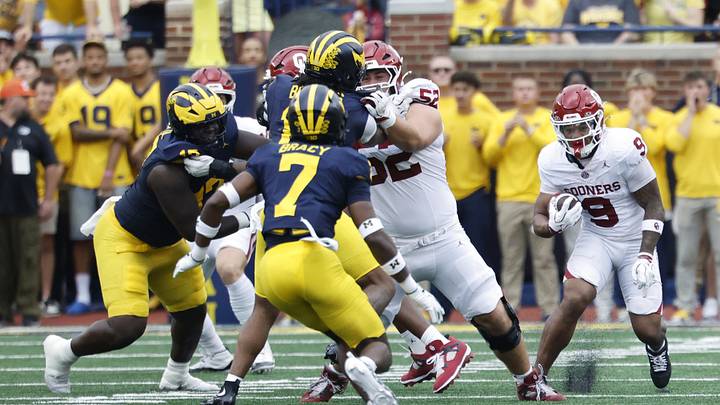
Against Michigan, admittedly a much hardier opponent, last weekend, the Oklahoma ground attack got off to another strong start. Colorado State transfer Lloyd Avant ripped off an eight-yard gain on the very first offensive snap of the game and averaged 6.6 yards per carry on five first-half carries. The Sooners produced 65 of their 100 total rushing yards for the game in the first half, and the bulk of that in the opening quarter.
The Sooners inexplicably and prematurely abandoned the run game in the second half, save for a number of quarterback scrambles and designed running plays by Mateer, choosing instead to go to the air despite the quarterback's repeated inaccuracy and inconsistency in throwing the ball.
Avant touched the ball just four times in the second half. The three running backs the Sooners used in the game (Avant, Xavier Robinson and Tory Blaylock) accounted for just 13 of Oklahoma's 29 rushing attempts in the game. Mateer had 13 rushing attempts and the other three were handoffs by Mateer to wide receiver Isaiah Sategna on end-around jet sweeps.
Mateer had one good quarter out of four. In the third quarter, he completed all seven of his pass attempts for 129 yards while leading OU on two scoring drives. But he was not the reason for the loss at Michigan.
It's difficult to say whether offensive coordinator Ben Arbuckles' play calls were the reason, or whether Mateer's failure to execute the plays was the principal cause. In truth, both deserve a piece of the blame, as does head coach Venables, who owns the ultimate accountability for Oklahoma's performance throughout the season.
At the moment, and candidly in the two seasons Arbuckle and Mateer have been at the primary controls of the Oklahoma offense, the offense has been struggling to find its true identity and the right buttons to push to bring it into better balance with what has become an outstanding Sooner defense and a special teams unit that is second to none.
Historically, Oklahoma football has long been recognized for its prolific, high-scoring offensive output and explosive rushing attacks. Three of the Sooners' seven Heisman Trophy winners were running backs, and since 2000, four OU quarterbacks have taken home the prestigious individual prize, with two others finishing in the runner-up spot.
In the Riley years, offensively, Oklahoma was able to score on any and all opponents, often. The problem was, the Sooner defense wasn't able to stop anybody from scoring. As the Sooners painfully discovered, that was not a formula for seriously contending for a national championship.
In the five seasons between 2016 and 2020, Oklahoma finished in the top-six nationally in total offense, including No. 1 in 2018 with Kyler Murray at quarterback and No. 3 in both 2016 and 2017 behind Baker Mayfield. It's not a coincidence that Riley, one of the best offensive play-callers in the country, was directing the Sooner offense during those years.
It also is not a coincidence that the year the Sooners' offensive performance was No. 1 in the nation, in 2018, the OU defense ranked 101st out of 130 FBS teams.
Enter Venables, one of the college football's most widely recognized and accomplished defensive coaches, in 2022 as the new Oklahoma head coach. It shouldn't be a surprise that, four years hence, the OU defense has become one of the very best in college football.
The Oklahoma defense has definitely taken on the identity and personality of its fiery, high-energy head coach: physical, aggressive and relentless. Oklahoma's great offenses of the past -- and there have been plenty of them -- always featured a definite identity that fueled the Sooners' winning ways.
It all starts with the head coach, and as far as the offense is concerned, the offensive coordinator and quarterback play integral roles. All three need to be the right fits for the opportunity and challenges of directing and leading the offense and, it goes without saying, share a common vision and the path to get there.
When all three of these pieces are in place and operating in tandem toward a shared vision and purpose, Oklahoma's offensive identity not only will become more obvious but increasingly difficult to counter.
 Add us as a preferred source on Google