

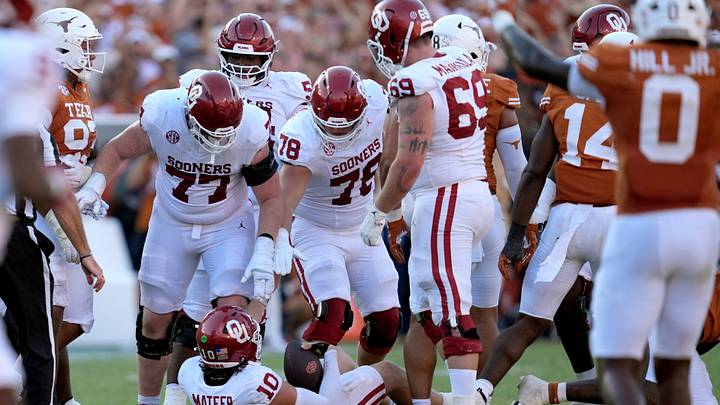
Oklahoma's offensive production approaching the midpoint of the 2026 season is at a nearly 30-year low point. Although there are multiple factors that have contributed to that historic downfall, the core of the problem rests with the offensive line.
Every offensive play begins and ends with the job being performed up front by the guys at the point of attack. The run game is impacted by the ability of the offensive linemen to block and create gaps and running lanes, and the passing game is only as effective as how well the first line of defense is able to protect the quarterback and keep him upright.
None of that is working very well for the Sooners this season, and as a result, Oklahoma is near or at the bottom of the SEC in most of the major statistical categories on offense and ranks worse than all but seven of the 138 teams that make up the Football Bowl Subdivision (FBS).
Changing faces and places at a position that is not the easiest to master is trouble for Sooners
Stability, communication, and consistency are probably the three main pillars of any successful offensive line, and if the same guys are not out there and playing together for more than a couple of games at a time, and often not more than one year at a time, it's pretty difficult to muster any kind of continuity or consistency. When there are breakdowns on the offensive line, bad things have a higher probability of happening in play execution.
For the third straight season, the Oklahoma offensive line has been decimated with injuries. This week alone, four offensive linemen were listed as questionable on the initial availability report, and that's been a continuing pattern the past few years. The Sooners' best offensive lineman, starting left tackle and former five-star recruit Michael Fasusi, has missed four of OU's five games this season after being injured in the opening half of the season opener against UTEP.
Fasusi's absence has forced offensive line coach Bill Bedenbaugh to move players around on the O-line. For example, Ryan Fodje, whose natural position is right guard, has moved over to left tackle, replacing Fasusi, and true freshman Noah Best has been thrust into duty perhaps a year earlier than expected, taking over for Fodje at right guard. Left guard Eddy Pierre-Louis has also been dinged up and missed the Texas game last weekend. Senior Heath Ozaeta filled in for Pierre-Louis against Texas after starting over him the game before.
This kind of mixing and matching on the offensive line has been the norm at Oklahoma for the past several seasons, but the ramifications of that have hit harder this season than at any time in the recent past.
Oklahoma is averaging 305 yards of total offense per game this season. That is the lowest it's been since 1998 (293 yards per game), John Blake's final season as the Sooners' head coach, one year before Bob Stoops arrived in Norman. The Sooners rank 101st nationally (out of 138 FBS teams) in points scored, 131st in rushing yards, 92nd in passing yards, 127th in third-down conversions, and 130th in first downs. That's beyond bad. If you're Oklahoma, that's horrific.
The Sooners also rank dead last in the SEC and are among the worst in the country in three other important offensive categories: quarterback pressures, sacks allowed, and negative plays. All are directly related to offensive line performance. According to SEC StatCat, 35% of OU's offensive plays result in a quarterback pressure, 11% in negative yardage, and 6.7% in a sack.
Thank goodness OU is blessed with one of the country's top defensive units. Otherwise, the Sooners probably would be winless this season.
Perhaps the Oklahoma offense will show some much-needed improvement the remainder of the season with a schedule that features opponents with much less defensive presence than the teams the Sooners have faced thus far. Four of Oklahoma's five opponents to start the 2026 season rank in the nation's top 13 in total defense. The Sooners, by the way, are No. 14 in that defensive category.
Four of the Sooners' remaining games are against SEC teams (Kentucky, Mississippi State, Florida,, and Ole Miss) that rank in the bottom third of the FBS in scoring defense and total defense.
It's interesting to point out that in 2017, Oklahoma was No. 3 nationally in total offense, and the following year, the Sooners led the country in offense. That same season (2018), Oklahoma won the Joe Moore Award, presented annually to the team deemed to have the best offensive line in college football. It's not a coincidence that those honors work together.
Fasusi reportedly is close to returning to action, which will be a huge boost to the offensive line, but the Sooners are limited in what they can do to get measurably better up front this season with a lack of depth and experience in that position group.
As far as addressing its offensive line issues beyond this season, Venables reminded reporters last week, "We've got six guys coming in in the '27 class. It's going to be incredibly important to bring back a good majority of the guys that are developing as we speak."
OU undoubtedly will also look to the transfer portal for talent and experience and, importantly, competitive depth in that vital position group.
 Add us as a preferred source on Google