

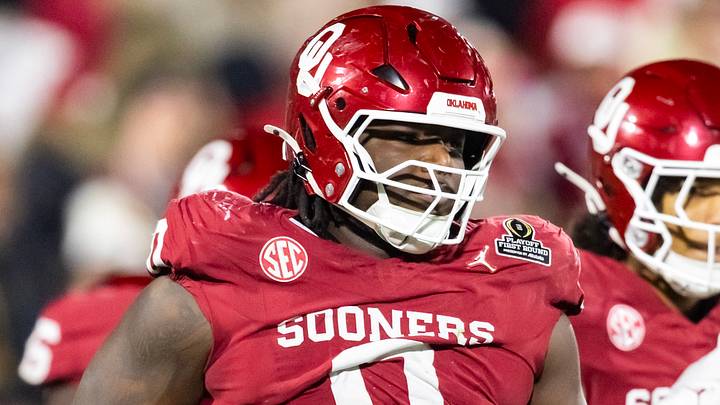
Nothing says Oklahoma football like the iconic crimson helmet adorned with the distinctive, interlocking white "OU" logo.
The OU helmet design may not be the most colorful or eye-grabbing, but it ranks as one of the best and most traditional in all of college football.
The classic red helmet has been a staple of the Oklahoma football uniform since the 1966 season. The interlocking OU logo also appeared on the side of the helmet for the first time that year. The helmet color was changed from white with red striping to red in 1966, coinciding with Jim Mackenzie's first and only season as head coach of the Sooners. Mackenzie succeeded the legendary Bud Wilkinson but died in the spring of 1967 of a heart attack.
The original version of the logo was more rounded in form. It was altered after one season and changed to a more block style of lettering, the thickness of which has changed slightly over the years. After the OU helmet was modified with the more rounded form of the school logo in 1967, that remained the helmet style for the next nine seasons.
The only thing that changed during the 10 years from 1966 to 1976 was the color of the face mask. A mix of white and gray face masks was worn by the players during this time. The face masks were predominantly white from 1967-71. Between 1972 and 1976, the color of the face masks changed to gray.
The red helmet color was changed to crimson in 1976 and the face mask color was standardized to white. This version of what has become the traditional crimson Oklahoma helmet remained in effect through the 1999 season, Bob Stoops' inaugural year as head coach of the Sooners.
The Oklahoma helmet underwent a slight modification in the 2000 national championship season. The crimson helmet color was updated with a richer, metallic paint.
While the traditional crimson helmet has remained the standard throughout the new millennium, OU has introduced several alternate uniform designs within the last decade as an occasional supplement to the traditional home and away uniforms.
Oklahoma was a late adopter to the alternate uniform design fashion trend fueled by Nike and Oregon. But the OU football program ultimately joined the party in 2014, introducing its "Bring the Wood" alternate uniforms. The uniform featured two different helmet designs: an alternate white helmet with crimson striping that paid homage to OU's national championship years in the 1950s under Bud Wilkinson, and an alternate red helmet featuring a woodgrain design inspired by the texture of the iconic Sooner Schooner.
The "Bring the Wood" alternate uniforms were retired after the 2021 season, but in 2022, Oklahoma introduced an anthracite gray uniform with a matching helmet that includes crimson striping down the middle. The Sooners refer to this as their "Unity" alternate uniform honoring the military.
In 2024, the team introduced an alternate throwback uniform that harkens back to the glory years of the Wilkinson era of OU football, including the white helmet with red striping and numerals.
History and tradition helped shape Sooners' classic look
The first half of the 20th century was a completely different era of college football. Although many of the originating rules remain in vogue today, the game was played much differently and the players were not as big, athletic or as fast as the modern-day athletes. The equipment worn by the players in the early days was dramatically different than today. Perhaps the biggest change was the changeover after World War II from the old-fashioned padded leather helmet to a more durable and safer helmet design made of hard plastic material.
The first of the modern era Oklahoma helmets was introduced in 1946, which also happened to be Bud Wilkinson's first season at OU. Wilkinson was hired as an assistant by then-head coach Jim Tatum, who left after the '46 season to take the same job at Maryland. The original Oklahoma hard helmet was white with a single red stripe down the middle.
The Sooners wore the original white helmet style for 11 seasons (1946-56), during which time OU captured its first three national championships in football, as well as 11 conference championships.
Oklahoma maintained the classic white helmet design for another nine seasons (1957-65) before converting to the present-day solid red design . Face masks became more prominent and varied in look over this time, and red numerals designating the players' uniform number were added to each side of the white helmet.
 Add us as a preferred source on Google