

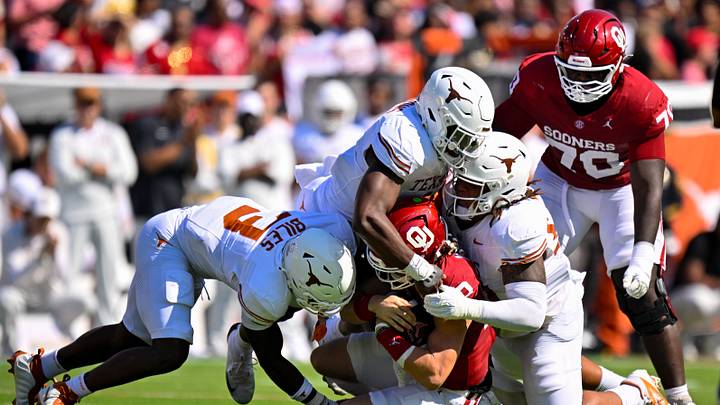
Oklahoma's national recognition as one of the greatest college football programs of all time is largely attributable to its powerhouse offensive teams that played under three head coaches spanning over seven decades.
The Oklahoma split-T offenses adopted under legendary head coach Bud Wilkinson produced three national championships, 14 conference championships, and an NCAA record 47 consecutive wins. Then there were the explosive wishbone offenses, invented elsewhere but perfected by Barry Switzer's Oklahoma teams of the 1970s and '80s, that led to three more national titles and 12 conference championships.
By the time Bob Stoops took the Oklahoma coaching reins in 1999, the Sooners began transitioning from a more run-heavy offensive approach to take advantage of spread formations that opened the field of play for a much more wide-open passing game that became known as the Air Raid offense.
Stoops won a national championship in his second season at Oklahoma, but he will also be remembered for producing four Heisman Trophy-winning quarterbacks. Oklahoma's top five career passing leaders -- Landry Jones, Baker Mayfield, Sam Bradford, Jason White, and Josh Heupel -- all played for Stoops.
All of that sadly is gone now. The Sooners have become a laughing stock in terms of offensive execution and productivity, and one has to wonder how on earth it has gotten so bad, with few, if any, signs of improvement.
Brent Venables has elected to ride out the 2026 race on a lame horse
Oklahoma coaching staffs have shown the courage and fortitude in the past, even under Brent Venables, to make changes as necessary when things are going poorly, but for whatever reason, this time they are sticking by their guns and have elected to stay the course, despite all the signs that suggest otherwise.
Through six games, quarterback John Mateer and the Oklahoma offense have been unable to generate any kind of sustained success. The Sooners are averaging just 21.3 points a game, as only three of 138 FBS teams have produced fewer first downs (99). Moreover, the Oklahoma offense has reached the red zone just 13 times. To be honest, it's a little surprising they've scored enough to win as many as three games.
Mateer's performance is front and center in all of this, and he continues to demonstrate the same problems every time out this season, including holding the ball too long, not getting the ball to open receivers, and making poor decisions with the ball. Against Georgia, for example, he fumbled twice and threw an interception that led directly to 17 of Georgia's 41 points in three straight possessions. He has accounted for 10 (seven interceptions and three fumbles) of Oklahoma's 14 turnovers this season.
The Sooners have two other quarterbacks on the active roster in freshman Bowe Bentley, a former top-10 quarterback recruit, and former Mercer transfer Whitt Newbauer, but both Venables and offensive coordinator Ben Arbuckle, who like Mateer came to Oklahoma from Washington State, insist that Mateer, despite his current struggles, gives the Sooners the best chance to win.
From this, we as fans can only conclude that the Sooners do not have a backup quarterback who is good enough to play at this level, which is a whole other disturbing problem, especially if you're a major program like Oklahoma. Newbauer and Bentley combined have thrown a total of two passes in live game action this season, appearing briefly in the Sooners' season opener this season. Mateer has taken every offensive snap since.
Why Venables and Arbuckle are not willing to at least take a look at either of the two backup quarterback options to see what they can do to change things up is difficult to comprehend, let alone accept. They may ultimately have to go back to Mateer, but at least take the effort to try something different instead of continuing down the same old beaten path only to see the same frustrating results.
Venables and company apparently have made the conscious -- or, some might say, unconscious -- decision to ride it out to the finish line on the same lame horse regardless of the consequences, good or bad. What makes this plan so hard to swallow is that going down with a sinking ship without doing anything to change the outcome is simply not an option at a proud and prized program like Oklahoma
Oklahoma is dead last in the SEC in total offense, averaging 311.5 yards per game. Fueling that number is a rushing offense (92.5 ypg) that ranks 16th out of 16 teams and a passing offense (219.0 ypg) that is 13th in the conference. It's becoming painfully clear that the Sooner coaches and executive staff swung and missed on Mateer when they brought him in from Washington State prior to the 2024 season, much like they did with highly touted five-star quarterback recruit Jackson Arnold, who preceded Mateer.
In last weekend's 21-13 home loss to Kentucky, Venables, in his postgame press conference, surprised some reporters when he said he liked the improvement he saw from Mateer in the game. This despite the fact that Mateer threw three interceptions in the game, including two in the final two minutes, and made numerous bad decisions with the ball, not seeing or trusting his ability to connect with open receivers.
Unfortunately, the Kentucky game was not a one-off situation in terms of poor performance and critical mistakes by Mateer this season. His confidence is as low as it has been in the two seasons he has been at Oklahoma, and he appears to be pressing and putting too much on himself in an effort to get things turned around offensively.
Oklahoma's offense was not good last year or the year before. In spite of this, the Sooners were able to win 10 games last season and go to the College Football Playoff, largely on the backs of a defense that was among the best in college football. We were led to believe that things would be much better on offense in 2026 because of offseason adjustments and player and staff personnel additions. Plus, the Sooners were returning a healthy Mateer after he played the second half of the 2025 season with a surgically repaired fractured thumb on his throwing hand.
Sooner fans, we were hoodwinked into believing a false truth. Instead of getting better, the 2026 edition of the Oklahoma offense has actually become much worse.
When it comes to a floundering, dysfunctional offense like Oklahoma's this season, the quarterback is always going to be the prime target of the blame game. And while Mateer should not rightfully shoulder all the blame for as bad as the Sooner offense has become, he clearly is the main contributor.
For the second or third straight season, injuries to key personnel have hit the Sooners especially hard on the offensive side of the ball. Oklahoma's inability to run the football is largely the result of a mostly patchwork offensive line and the inability of the O-line, even when healthy, to block anybody or get push at the line of scrimmage. That has forced the Sooners to go to the air more than they might want to and made the Oklahoma offense more predictable for opposing defenses.
There isn't enough time or games left to fix all of the Sooners' offensive problems, or maybe any of them, before the end of the season. But this is Oklahoma, and this untenable situation cannot be allowed to persist beyond the final whistle this season.
Sad to think that if the Oklahoma offense were performing even at just an average level this season, the Sooners would be sitting at 5-1 right now instead of 3-3. Instead, we're battening down the hatches and riding out the storm, hoping for the best.
 Add us as a preferred source on Google