

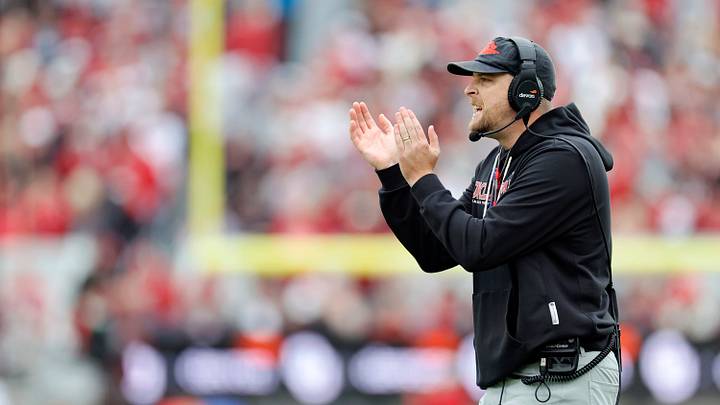
The college football season is nearly upon us, and the country is buzzing; you can feel it in the air. Fall is creeping in before the temperatures change, as it always does, and the questions still remain. What makes the start of the season so exciting is that no one knows the answers, but we will soon all find out the truth about our teams and their competitors. One of Oklahoma’s biggest questions still remains: What will offensive coordinator Ben Arbuckle’s offense look like this year with a healthy John Mateer at quarterback and all the new talented additions? None of us know the future, so our only option is to look into the past.
In 2003, Moneyball: The Art of Winning an Unfair Game by Michael Lewis was published, showing how the Oakland Athletics used data analytics to outperform their opponents in MLB. Since that book and the later film adaptation, sports data has not only boomed in its use with teams, but the casual fan has now taken an interest in the advanced statistics recorded and what that can tell us about our favorite teams. College football was no exception. What can data tell us about college football?
A massive amount of data is collected every time a play is run. Run or pass, who touched the ball, how far did it move, what down was it, where was it on the field, etc. All of this can paint a picture through numbers that can give us insights that one may not notice, even if they watched every snap.
Using my background as a data analyst, I pulled the play-by-play data from the 2024 Washington State offense and the 2025 Oklahoma offense to see how Arbuckle’s offense has performed with Mateer as his quarterback ahead of Year 3 with the duo.
A data analysis of Ben Arbuckle's Oklahoma offense with John Mateer
Play-call by down
The first piece of data we will look at is Arbuckle’s play-calling tendencies. On first and second downs in both 2024 and 2025, Arbuckle showed very similar tendencies.
First downs in both seasons saw roughly 40% pass and 60% rush play-calls, while second downs saw roughly 57% pass and 43% rush. The real difference is on third downs. In 2024 at Washington State, the ration was 55% pass and 45% rush, which is a fairly balanced ratio. In 2025 at Oklahoma, third downs saw nearly 70% passing play calls, while only 30% of plays were running the football.
Last season, Arbuckle was heavily relying on throwing the ball on third downs despite Mateer recovering from a broken thumb for most of the season. This is a direct result of the poor running game that was on display last year for Oklahoma. First downs were hard to come by for the Sooners, and seeing the one-dimensional third-down offense shows why teams were so effective at ending drives on third down.
— Hudson Haws (@HawsSports) August 31, 2026
Explosive plays
Next, we will look at explosive-play rate. In this model, we are defining an explosive play as any play that gains 10 or more yards. Explosive plays on offense can define a game and be the difference in a win or a loss.
There were many times last year where if OU got an explosive play on offense, it felt like the nail in the coffin for its opponent because of the Sooners' elite defense being able to hold onto a lead and carry the momentum. In 2024, 35% of all passes turned into an explosive play for Washington State. Oklahoma in 2025 only produced an explosive play from a pass 25% of the time. This was a 10% drop-off from the year prior.
— Hudson Haws (@HawsSports) August 31, 2026
In the modern game, there is no longer such a thing as a succeeding one-dimensional offense. The last remnants of those offensive schemes can only be seen being clutched by coaches at the U.S. Military Academies. Oklahoma could not run the football effectively, forcing it to rely on passing. As a result, opposing defenses knew what to expect. The run game could never get going, so the passing game could never break out of its shell. The modern offense has to have multiple avenues of attack. If one of those is not clicking, the entire machine crumbles under the weight of its own deficiencies.
Average yards per play
Last, we will look at the average yards per play from both offenses. In 2024, Washington State produced more than seven yards per play in seven of the 13 games it played. Oklahoma only produced a seven-plus yard average twice in 2025.
This may not come as a shock, but the key point here is the last time Oklahoma produced more than seven yards per play was Week 3, prior to Mater's injury. During the season, the injury was downplayed by the university and by Mateer himself. It is evident looking back that the injury had a profound effect on the efficiency of Mateer, Arbuckle and the entire Sooner offense.
— Hudson Haws (@HawsSports) August 31, 2026
Arbuckle and the Sooner offense are capable of producing good performances. It was on display at the start of the 2025 season. With the new pieces added from the transfer portal, Arbuckle’s play-calling tendencies and the effectiveness of plays should return to what they have previously been. If the Oklahoma offense can break out of its one-dimension scheme and open up other avenues of attack, the explosive play rate and yards per play average will see a substantial increase. If that is shown on the field, this Oklahoma team will become an entirely different animal with its sights set on a title. Keep an eye out for a more consistent run game. When you see that, be ready, because the explosive plays will be sure to follow.
 Add us as a preferred source on Google